

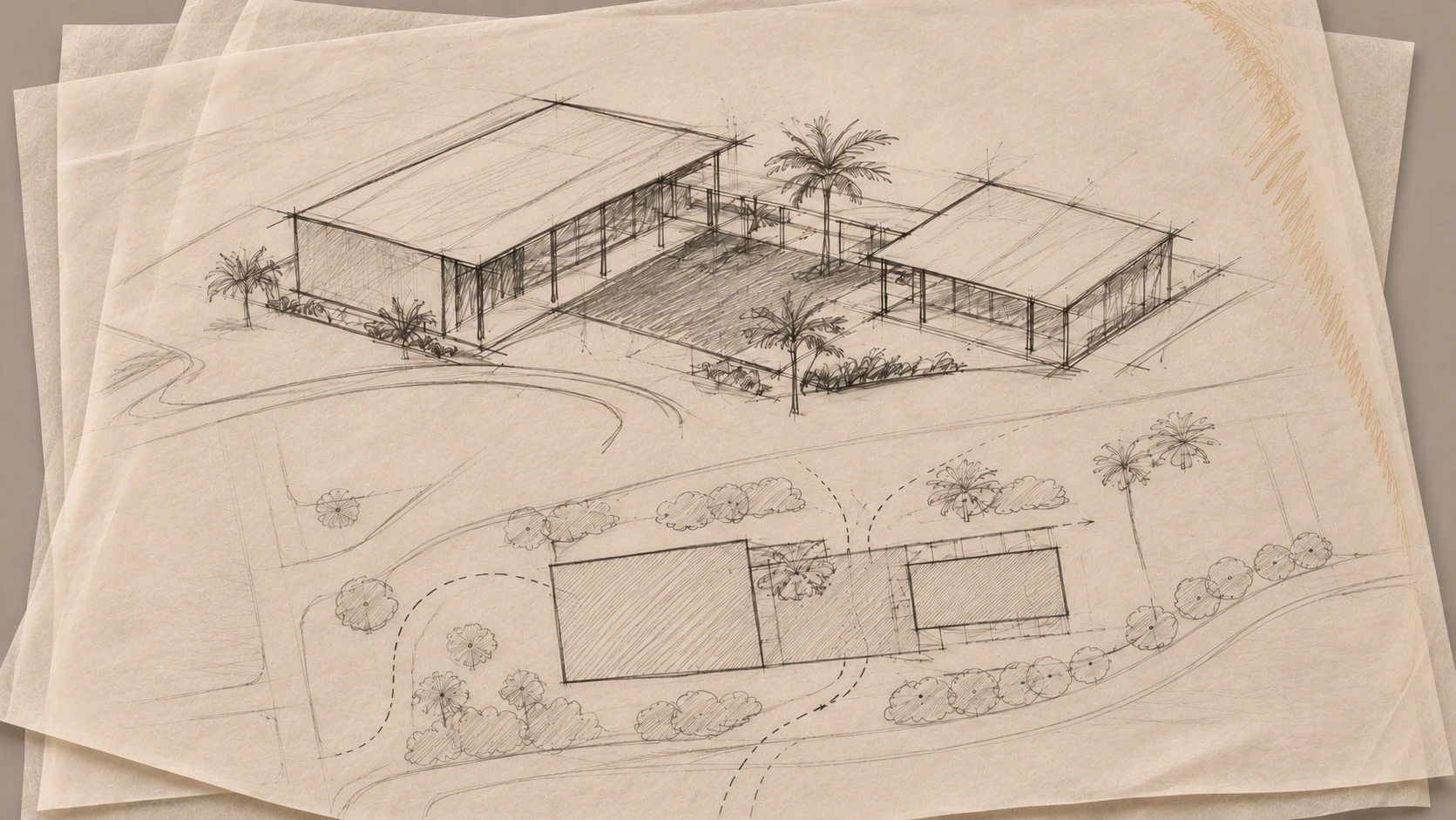
Start with the purpose, not the picture
Every project begins with an ambition. Before that ambition becomes a drawing, it needs a clear brief: who the place will serve, what it must accommodate and how it will work over time.
An attractive image can communicate a direction. It cannot, on its own, resolve the decisions behind it. A neighbourhood destination, for example, must answer different questions from a landmark intended to attract visitors from across a city. Frequency of use, access, scale and the mix of activities all influence the architectural response.
Our starting point is a simple question: what should this project make possible? The answer gives the team something more useful than a style preference. It establishes a purpose against which design choices can be tested.
Build a brief that can guide decisions
A useful brief brings the site, the programme and the operating model into the same conversation. It identifies the spaces people need, the relationships between them and the supporting functions that allow the project to work.
The less visible requirements deserve attention early: servicing, storage, circulation, maintenance and the movement of staff as well as visitors. These are not details to fit into whatever space remains. They are part of the project’s logic.
Commercial considerations belong in this conversation too. A programme should be tested against realistic assumptions about demand, delivery cost and operation. More floor area is not automatically more value; a space that is difficult to use or maintain may undermine an otherwise compelling concept.
Use design to test the idea
The first options are an opportunity to compare, not simply to choose a favourite image. What does each arrangement make easier? Where does it introduce complexity? Which assumptions still need evidence?
A clear design process separates decisions that are ready to be made from questions that need investigation. Site information, authority requirements, specialist input and commercial assumptions can develop at different speeds. Making those dependencies visible helps the team avoid treating an early concept as a fully resolved promise.
Give the next stage a sound foundation
A strong concept is not a finished building. It is a direction with enough clarity to move forward: a coherent programme, a credible spatial arrangement and an honest account of what remains to be resolved.
Architecture and strategy are most useful when they inform one another. The aim is not to make the brief more complicated. It is to make the important choices clearer, before they become difficult to change.